Beliefs are not facts. They are tools.
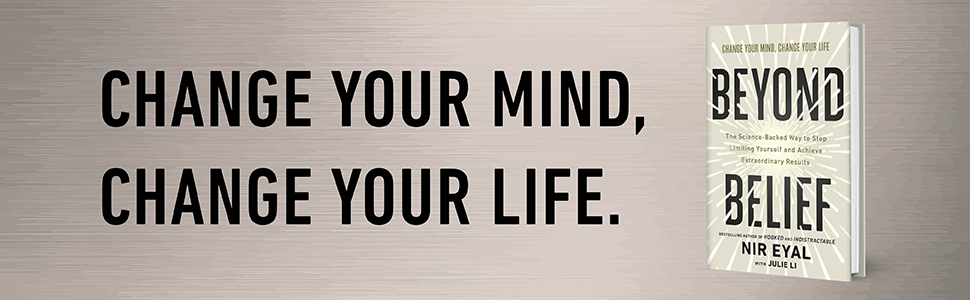
In Beyond Belief, Nir Eyal explores how personal beliefs shape our behavior, health, and performance. Drawing on recent scientific research, the author of Hooked examines how the beliefs we hold about ourselves can either limit us—or unlock profound change.
Hello Nir Eyal, why did you write this book… now?
Nir Eyal : I spent years studying how habits and distraction shape behavior, but the deeper I looked, the more I kept running into something more fundamental: the beliefs people hold about themselves. Not their habits, not their environment — their beliefs. I watched smart, capable people stay stuck not because they lacked skill or opportunity, but because they held a quiet conviction that change wasn’t really possible for them. I wrote Beyond Belief because the science on this is extraordinary and almost nobody is talking about it. Research shows that what you believe about your own aging, your health, your potential — these beliefs have measurable, sometimes dramatic effects on outcomes. That felt urgent to share.
An extract that best represents you?
N. E. : This passage from the book captures it well: “Beliefs are not facts. They are tools. And like any tool, the question isn’t whether they’re true — it’s whether they’re useful.” That single reframe is the engine of the entire book. We’ve been taught to evaluate our beliefs by asking, “Is this accurate?” But the more powerful question is: “Is this belief helping me, or holding me back?” Once you see beliefs as tools you can pick up or put down, everything changes.
The trends you believe in most?
N. E. : Two things. First, the science of expectation effects is moving fast. We’ve known for decades that placebos work, but researchers are now mapping exactly how belief alters physiology — hormone levels, immune response, even lifespan. Becca Levy at Yale found that people with more positive beliefs about aging live an average of 7.5 years longer than those with negative ones. That’s not motivational speaking. That’s hard data.
Second, I think we’re entering a backlash against the victimhood narrative — not because suffering isn’t real, but because people are starting to recognize that a diagnosis or a label, however valid, can become a ceiling. High agency isn’t about denying difficulty. It’s about refusing to let difficulty define what’s possible.
One piece of advice?
N. E. : Audit your beliefs the way you audit your finances. Most people accept their beliefs as facts without ever questioning where they came from or whether they still serve them. Take one belief you hold about yourself — “I’m not a morning person,” “I’m bad with money,” “I’m too old to change” — and ask: where did this come from? Is it actually true? What would be possible if it weren’t? You don’t have to flip to blind optimism. You just have to stop treating an old story as a permanent truth.
What topics will you be passionate about next?
N. E. : I’m increasingly interested in the institutional dimension of belief — how organizations and cultures transmit limiting beliefs to the people inside them. A lot of leadership development focuses on skills and strategies, but the hidden variable is often the unspoken beliefs a company holds about its people, its market, or what’s possible. I think that’s the next frontier for behavioral science applied to business.
Thank you Nir Eyal
Many thanks Bertrand Jouvenot
The book: Beyond Belief, Nir Eyal, Portfolio, 2026