Technology served people, people did not serve technology
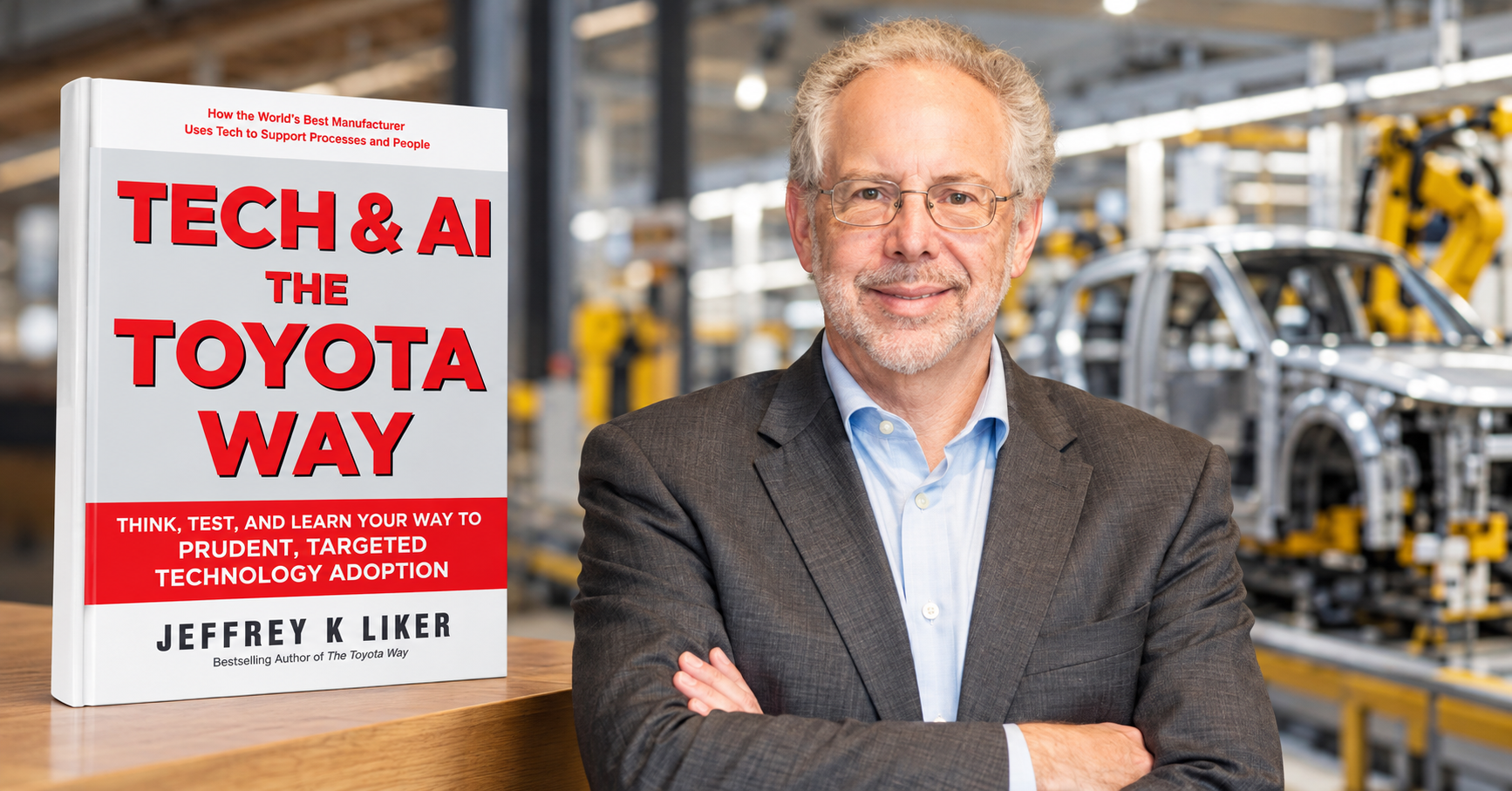
In Tech & AI The Toyota Way, Jeffrey K. Liker, bestselling author of The Toyota Way, challenges the rush toward artificial intelligence. Drawing on decades of research into Toyota’s management philosophy, he explains why successful technology adoption begins with people, processes, and real-world problem solving.
Hello Jeffrey K. Liker, why did you write this book now?
Jeffrey K. Liker: I began studying the social impacts of technology and how they were deployed when I joined University of Michigan as an assistant professor of Industrial and Operations Engineering in 1982. At that time all the rage was Computer-Integrated Manufacturing that would connect design, engineering, manufacturing preparation, and manufacturing seamlessly. This would ultimately lead to the dark factory without people. Sound familiar? It did not work. Each step required a huge amount of intervention by humans including in the factory where the automated systems were shut down much of the time. General Motors bet big on these systems to the tune of $90 billion in dollars back then and finally gave up. In the mean time Toyota was experimenting with the Toyota Production System (TPS) at a joint venture with General Motors, called NUMMI in California making Toyota Corollas and GM badged cars. TPS had evolved in Japan since World War II and was a finally tuned machine there but Toyota was concerned about making it work overseas. In they first year they hit it out of the park at NUMMI with lowest cost, highest quality, and on-time delivery. Yet Roger Smith, the CEO of GM, preferred to buy technology to compete. The lessons at that time have stuck with me as I look at the mania around AI with promises of superintelligence which will take over all but the most technically advanced jobs, and ultimately possibly wipe out humanity. I do not buy it. I buy that generative AI can do incredible things and is a new type of tech, but as we see organizations attempt to use it to replace people we learn of one after another disappointment. The theoretical potential of the tech is endless, but the actual use has to fit with real-world processes and people.
I personally have been involved many times with applying TPS to organizations with stunning results. And just as we were making progress a decision would be made at the senior ranks to introduce new digital solutions and all our great work would stop to get the new computer systems up and running. This was disheartening.
I felt with all the AI and digitalization mania going on now it was the right time to take a more measured, and rational look at what we can do wrong in introducing this technology and how we can do it right. We have lots to learn and it will take many years.
So I wrote Tech and AI The Toyota Way. The subtitle tells the story: Think, Test, and Learn your way to Prudent Targeted Technology Adoption. The key is we have to be thoughtful, we have to run the experiments, not in general, but in specific cases of specific problems, and we need “technology solutions” to be targeted to the right applications. We need to think like scientists, not like doers who are just trying to implement off-the-shelf solutions.
Which excerpt from your book best represents who you are?
J.K.L.: Here is some excerpted text from the Preface:
I was hooked on computers as an undergraduate Industrial Engineering (I.E.) student at Northeastern University in 1977… I found computers fascinating. But I found people more fascinating—psychology, sociology, ways of designing work…
As an assistant professor of industrial and operations engineering at The University of Michigan, I was excited by an opportunity to study my twin passions of technology and people when a group of us got together in 1985 and studied one small maker of bearings for conveyance systems..
We interviewed most of the employees while the plant was undergoing transformation and to our surprise reality bore little resemblance to what the gregarious CEO had described to us in his cushy offsite office. We did find there were some winners who were engaged with the new technology and spoke the party line of a stunning future for the company. But there were even more losers struggling to get bearings out the door with the old machines. As it turns out, the losers had the last laugh as they were the only ones who could successfully make product while engineers struggled to keep the new shiny Computer-Numerically-Controlled (CNC) machines running.
These days it is artificial intelligence that is all the rage and companies are spending millions of dollars, in some cases billions, desperately searching for quick applications. What can we revolutionize with AI? We search desperately for the nail to our hammer. Some companies are firing thousands of employees in anticipation of the productivity benefits of AI only to find employees spend more time correcting the AI then doing the original work themselves. In my news feed I regularly see stories of companies that fired many of their software coders because AI could do their jobs, only to rehire many of them when the AI coding falls short of expectations.
Fortunately, I discovered Toyota around the same time and began to study their management systems that actually worked, with high performance. This led to my writing The Toyota Way with Toyota’s help by opening their doors to my research. I organized the book around 14 principles that were categorized as 4Ps—Philosophy, Processes, People, and Problem Solving. Technology was part of the processes that have come to be known as Lean processes—getting more out of less. Less often includes less sophisticated technology than their competitors. The philosophy is long-term systems thinking. Toyota’s mission is to serve society and prosper as a company and to share the wealth with their members and partners and society at large…
Toyota’s view of technology was as a tool, sometimes a powerful tool. But it was always in the service of people, from team members working production to maintenance to engineering to support functions; technology served people, people did not serve technology…
Toyota’s targeted and prudent approach shows that sustainable progress comes from helping its people see, understand, and fix problems in the real world first, instead of papering over problems with expensive, opaque tech solutions. Toyota prioritizes thoughtful development and improvement through people, processes, and technology, with a bias against big, expensive “black box” tech solutions. One can say their mantra is “slow and steady wins the race.” Why is it so hard to see that engaged people, highly skilled in problem solving and creative thinking, are the key to agility and high performance in our complex world?
Which emerging trends do you believe in most?
J.K.L.: They say you can’t teach an old dog new tricks. Maybe I am an old dog. I still believe firmly in the Toyota Way and Toyota Production System (TPS). They have been around for about 80 years. Both have been represented as houses. The TPS house has two pillars—Just-in-Time and Jidoka, sometimes called Built-In Quality. JIT is about delivering the highest value to the customer without waste. Jidoka is about finding the right balance between humans and machines where machines do whatever routine tasks they can and humans are in control and the main problem solvers. The foundation is standardized, stable processes and in the center are people continually improving using all our creativity and problem solving ability. Jidoka is also the home of the andon—figuratively or literally stopping when there is a problem rather than letting it propagate through to the customer.
The Toyota Way pillars are Continuous Improvement and Respect for People. People are viewed as part of the team long term, not disposable bodies and brains. Continuous Improvement is rooted in deeply understanding the “gemba” the actual place where things are happening. Even senior executives at Toyota spend a lot of time at the gemba immersed in reality so their policies and decisions are grounded and realistic.
Of course, AI as it is being thought about and practiced violates much of this thinking. The goal seems to be to replace human thinking with computer thinking wherever possible, ideally laying off thousands of people who are no longer needed. It is the opposite of respect. And it assumes that this digital tool, that has been aptly described as a “stochastic parrot” can think creatively and solve problems on its own. Evidence so far is not so much.
Like any tool the first Toyota question is: What is the problem we are trying to solve? What are your biggest problems as an organization that prevent us from realizing our vision? When this is clear there is some combination of people, processes and technology that can help you get there. But it is rarely technology alone. And it may be that if you develop exceptional people with well-defined processes you only need simple technology. That has generally been Toyota’s experience.
If you could give readers just one piece of advice, what would it be?
J.K.L.: Don’t panic, stop, reflect, and consider what you need as an enterprise to be successful. Set some clear and stretch goals. Then go and see the reality and start in small areas to experiment with improvements. Solve some real problems. At first make the changes that you can make fast, to learn quickly. Over time you may see opportunities or technology to enhance the work of people. At the same time experiment with AI mainly on office tasks where the cost of failures is small. Of course, if you are a tech company selling “digital solutions” then all bets are off and you need to learn the new tech and get it into use more aggressively. Still, stop and ask: Who is the customer? What problems am I trying to solve for the customer? Take the time to understand how your customer is using your tech and where there are opportunities for improvement. Continuously improve.
In a nutshell, what topics will you be passionate about next?
J.K.L.: I have published twenty books. I thought I was done, but it was actually my original editor of The Toyota Way who encouraged (to put it politely) me to write this new book. I am hoping to retire from writing books, but I will never say never.
Thank you Jeffrey K. Liker
Many thanks Bertrand Jouvenot
The book: Tech & AI The Toyota Way, Jeffrey K. Liker, Wiley, 2026.